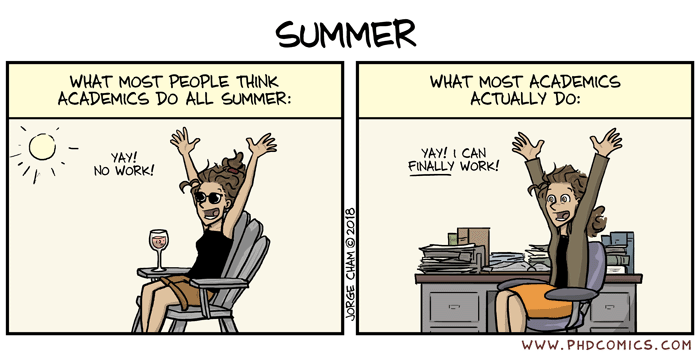
When I tell people I’m going on sabbatical this coming Spring, they often imagine rest, travel, and long stretches of downtime. For me, it feels like the opposite. This sabbatical is a rare block of uninterrupted time to learn and to work. Every day feels like a rare opportunity to get things done.
I’ve been thinking carefully about what I want to accomplish, and a few core goals have emerged.
1. Mastering the Localify Codebase
One of my top priorities is to fully understand and meaningfully contribute to every part of the Localify.org system. That includes:
- Frontend and Backend Development: React (Web), Spring Boot (Backend), Swift (iOS)
- Data Collection: Selenium-based Python scrapers
- Dashboard Tools: Monitoring our progress in terms of users, data, and impact
- Recommender System: explore alternatives to our existing matrix factorization-based recommendation algorithm (See #2 below)
- Infrastructure and Practice: DevOps, MLOps, Docker, CI/CD, test-driven development, etc.
The goal here is to develop a level of mastery akin to what some of my top former students (Paul Gagliano, Griffin Homan, April Trainor) had achieved during their time in my lab. I want to be able to reason about design decisions across the tech stack and improve the system holistically. This will also help me onboard and work with my undergraduate students on Localify.
2. Researching Steerable Recommender Systems
For the past 15 years, user interfaces for media-centric recommender systems (think Netflix side-scrolling carousels) haven’t changed much. Newer LLM-based conversational interfaces (e.g., ChatGPT) are undoubtedly powerful, but consuming large amounts of text is slow and burdensome for users, especially when they want to explore many media items. With these two observations in mind, here is what I’d like to work on:
- Exploring new affordances that large language models introduce for recommender systems
- Designing new UI/UX patterns that make those affordances visible and usable
- Developing mixed systems that combine traditional recommender approaches (e.g., matrix factorization) with LLM-based components
- Finding better ways to evaluate the quality and usefulness of LLM-driven recommendations
I’ve already been working on this problem both through a research collaboration at Cornell with Thorsten Joachims, Joyce Zhou, and Weijie Zhou, and with some of my students at Ithaca College on a movie recommendation app called CinAIma.
3. Agentic Programming and Modernizing Software Engineering Practice
Another major focus is strengthening my software engineering practice, especially around agentic and AI-assisted workflows. My undergraduate students are way ahead of me on this, and I’d like to catch up by:
- Experimenting with generative coding tools (e.g., Copilot, Cursor, Claude Code)
- Developing a more principled, hands-on understanding of cloud infrastructure on AWS
The goal isn’t to chase tools for their own sake, but to understand how they genuinely change how we design, build, and maintain complex systems. In addition to helping with my own projects (see #1 above), the hope is to be incorprate what I learning in my courses like full-stack web development and software engineering.
4. Staying Plugged into the Research Community
Finally, I plan to stay actively engaged with talks and research groups at Cornell, including:
- Research group meetings
- The AI Seminar
- Information Science (IS) talks
- ML, HCI and HAI-related events
Exposure to new ideas, especially outside my immediate focus, has always been one of the best ways I’ve found to sharpen my own thinking. Being in the room and hearing from talented researchers about work they are passionate about can be both inspiring and motivating.
A Daily Research Log
I’m planning to keep a daily research log throughout the sabbatical. Partly, this is about documentation. But more importantly, it’s about accountability—to myself. I want a concrete record of what I learned, what I tried, what worked, and what didn’t, and a way to resist getting pulled into busywork or low-value distractions.
Thank You
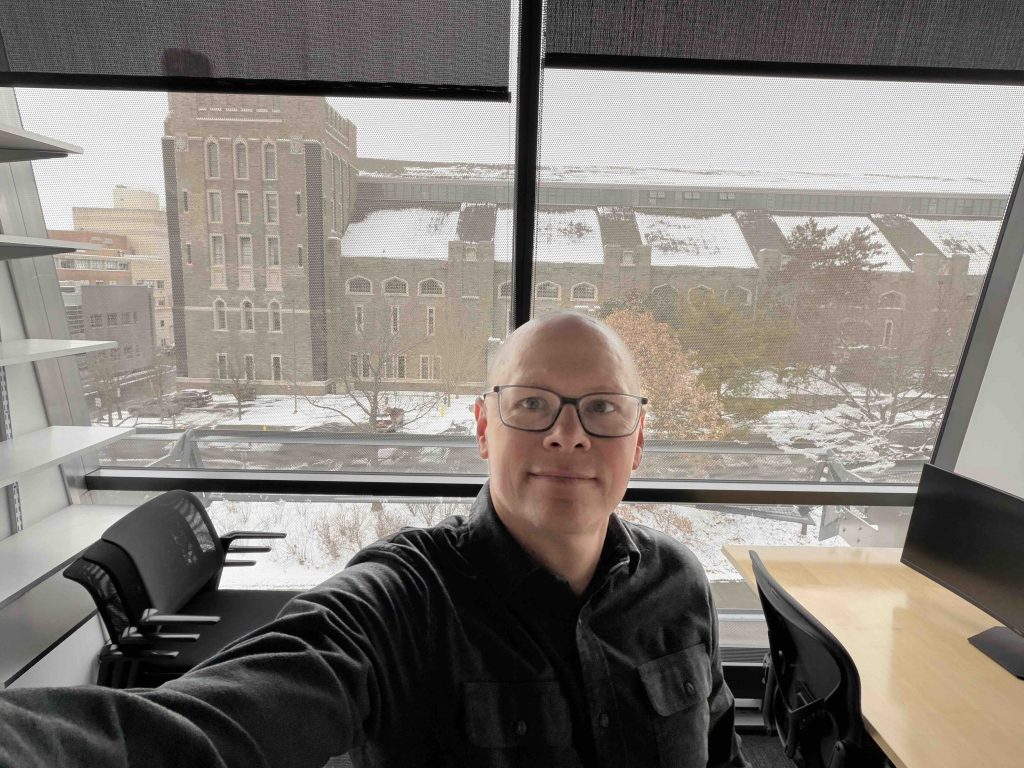
Finally, I would like to thank Thorsten Joachims for offering to host me for my sabbatical. We have been collaborating on interesting research since I moved back to Ithaca 15 years ago. One of his last acts as the outgoing interim dean in the Bowers School of Computing at Cornell was to set me up with a wonderful faculty office in Gates Hall. My plan is to use coming to the office as a forcing function to stay focused and get stuff done.
Time is the real resource here. It’s time to use it well.